Nassau County District Court serves as the primary trial-level court for many everyday legal matters across the county. It handles a high volume of cases that affect residents, drivers, and local businesses on a daily basis. This court focuses on matters that require timely hearings and structured procedures. Many people encounter this court during their first legal experience. The court operates with limited jurisdiction rather than full felony authority. Judges manage busy calendars to keep cases moving efficiently. Courtrooms address routine legal issues that arise within the community. Proceedings follow New York State law and local court rules. The court’s role supports fairness and consistency at the local level.
The district court Nassau county NY system places this court below higher trial courts in the county hierarchy. It functions as a local criminal court Nassau County residents commonly appear in. Early-stage felony matters begin here before transfer to County Court. Misdemeanor cases often remain here through resolution. Traffic violations and vehicle-related charges form a large portion of the docket. Arraignments take place soon after an arrest or summons. The court serves towns and unincorporated areas without village courts. Its position helps balance workload across the Nassau district court system. This structure keeps routine cases organized and efficiently processed.
What Is the Nassau County District Court?
District Court Nassau County NY is a trial-level court that hears many everyday criminal and traffic cases. It serves as the starting point for most local court proceedings in Nassau County. The district Nassau county court NY operates as a court of limited jurisdiction within New York State’s Unified Court System. Its primary role centers on handling cases that require quick review and structured hearings. Judges in this court preside over matters that affect daily life across the county. The court focuses on efficiency, clear procedures, and timely case movement. Many residents first encounter the justice system inside this courtroom. The court applies state statutes along with county-level rules. Proceedings follow formal legal steps that protect the rights of all parties. Court calendars move quickly due to heavy case volume. This court plays a key role in keeping the local justice process stable.
Legal Role and Authority
As a trial court Nassau County, the District Court has authority over specific case types. It hears criminal cases that do not rise to felony trial level. Civil authority remains limited compared to higher courts. Judges conduct arraignments, hearings, and non-jury trials. The court reviews evidence, issues rulings, and sets case schedules. Prosecutors and defense attorneys present arguments during proceedings. Court clerks manage filings, records, and case flow. The court’s structure allows prompt handling of routine legal disputes. This setup supports orderly case resolution.
Difference Between District Court and Higher Courts
The District Court differs from County Court and Supreme Court in scope and authority. Felony trials take place in higher courts. Civil cases with higher monetary limits move upward as well. District Court judges do not preside over jury felony trials. Their work centers on early-stage and lower-level matters. County Court reviews serious criminal charges after initial steps conclude. Supreme Court handles complex civil litigation and major legal actions. Each court level carries distinct duties. This separation helps prevent delays and overcrowding. The system remains balanced through clear jurisdiction boundaries.
Why Most Criminal Cases Start Here
Most criminal cases begin in this lower criminal court due to state procedure rules. Arrests lead to arraignments scheduled in District Court. Bail decisions and charge reviews occur early in the process. Misdemeanor cases often stay here until resolution. Felony cases pass through for initial hearings. This process creates orderly first-level court proceedings. Early review helps determine next steps quickly. Defendants receive formal notice of charges at this stage. The court’s position allows swift action without higher court involvement. This structure supports fairness and consistency across Nassau County.
How to Search Nassau County District Court Cases
The steps outlined below explain how to search Nassau County District Court cases using the official New York State court system. This process helps users locate accurate case details directly from government-maintained records. By following each step in order, users can check active criminal cases, confirm upcoming court dates, and review basic docket information. The instructions focus on the authorized WebCrims Case Identifier Search, which displays public case data for matters with future court appearances. Using this step-by-step method supports reliable results and avoids confusion caused by unofficial or third-party sources.
Open the Case Identifier Search Page
Visit the Case Identifier Search page on the New York State court system website:
https://iapps.courts.state.ny.us/webcrim_attorney/CaseIdentifierSearch
This form is part of the official WebCriminal / WebCrims portal provided by the New York State Unified Court System and is designed to show criminal case information with future appearance dates.
Enter Your Case Details
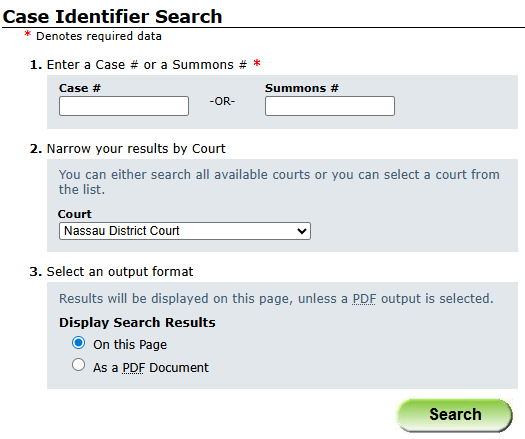
You will see a simple search form. On that page:
- Case no. or Summons no. – Enter the full number exactly as shown on your court notice or citation.
- You may narrow by court by selecting Nassau District Court from the dropdown.
Case Number Format
- Use hyphens (
-) exactly as on the document. - Include all parts of the case number (prefix, year, suffix).
- If you use a summons number, enter it without hyphens.
Select the Court
In the Court dropdown menu:
- Scroll down to Nassau District Court and click it .
- This helps narrow results so you don’t get cases from other New York counties or city courts.
Run Your Search
Click the Search button. The system will then display:
- Case details for matters with future court dates
- Court appearance dates and times
- Basic case status and scheduling information
What You Will See
WebCrims shows current and active criminal cases with scheduled appearances. Examples of data usually included:
- Case number
- Court location
- Hearing calendar and next appearance
- Procedural status (adjourned, active, etc.)
What You Won’t See in WebCrims
This official search will not display:
- Sealed or confidential records
- Cases with no future appearance date
- Full legal filings or detailed courtroom documents
- Records removed by court order
Types of Cases Handled by Nassau County District Court
Nassau district court cases cover a wide range of lower-level criminal and traffic matters filed each year. This court handles high-volume cases that involve day-to-day legal issues across Nassau County. The Nassau County District Court focuses on cases that require timely hearings and structured procedures. These matters affect residents, drivers, and visitors throughout the county. Many filings relate to criminal charges that do not reach felony trial stage. Traffic-related offenses form another large portion of the docket. The court also plays an early role in felony screening before cases move forward. Each case type follows defined legal steps under New York law.
Misdemeanor Criminal Cases
Misdemeanor filings make up a significant share of nassau district court cases. These are criminal charges that fall below felony level. The court reviews evidence, conducts hearings, and resolves many of these cases without transfer. Most misdemeanor matters begin with an arraignment, where charges are formally presented. Judges address bail conditions or release terms at this stage. Prosecutors outline the alleged conduct tied to the offense. Defense counsel responds on behalf of the accused party. Many cases proceed through motion practice or scheduled conferences. A large portion reach resolution through plea agreements or bench trials. This process allows the court to handle criminal misdemeanor cases efficiently within its authority.
Common misdemeanor charges include:
- Theft-related offenses
- Assault in the third degree
- Criminal mischief
- Drug possession under set limits
- Harassment and related offenses
New York law divides misdemeanors into two main categories.
- Class A misdemeanors: It carry higher penalties. These charges may result in jail time of up to one year. Fines and probation often apply based on the offense.
- Class B misdemeanors: It involve lower penalty ranges. Jail exposure reaches up to three months. Courts often impose fines, conditional discharge, or short probation periods.
Judges in the District Court handle arraignments, motion hearings, and non-jury trials for these cases. Many criminal misdemeanor cases reach resolution at this level without movement to higher courts.
Traffic Violations & Infractions
Traffic matters form one of the most common case categories in traffic court Nassau County proceedings. These filings relate to violations of New York Vehicle and Traffic Law. The District Court schedules large traffic calendars throughout the year. Some traffic matters remain infractions with monetary penalties. Others carry misdemeanor status under state law. Driving without a license or repeated offenses may lead to criminal charges. Judges review officer testimony, citation details, and driver history during hearings. Traffic cases often move faster than criminal matters. Many resolve through pleas or scheduled hearings. Serious violations may involve fines, surcharges, or license consequences.
Frequent traffic violations Nassau County residents face include:
- Speeding citations
- Driving without a valid license
- Operating an unregistered vehicle
- Failure to obey traffic signals
- Suspended or revoked license offenses
Preliminary Hearings & Case Transfers
The District Court holds an important position during early felony processing. Felony arrests begin in this court before any transfer takes place. This stage involves preliminary criminal hearings that review evidence sufficiency. During these hearings, the court evaluates probable cause. Prosecutors present initial proof. Defense counsel may challenge the evidence. Judges decide whether the case proceeds. Felony trials do not take place in the District Court. Once screening concludes, qualifying cases move upward. This early review helps control case flow and prevents unnecessary higher court filings. Through this structure, the Nassau County District Court supports orderly processing across the criminal justice system.
Case transfer process steps include:
- Initial arraignment in District Court
- Preliminary hearing or waiver
- Felony screening decision
- Transfer to County Court if required
Nassau County District Court Arraignment Process
An arraignment is the first court appearance after an arrest or summons in Nassau County District Court. During this hearing, charges are formally presented and initial court decisions are made. The arraignment stage plays a major role in many nassau district court cases. It sets the tone for how a criminal matter will move forward. This hearing usually takes place shortly after an arrest or ticket issuance. Defendants appear before a judge in open court. The session follows a structured format set by New York criminal procedure law. Court staff, prosecutors, and defense counsel all take part. The process moves quickly, yet each step carries legal weight.
What Happens During an Arraignment
During the arraignment, the judge calls the case and confirms the defendant’s identity. The court then states the criminal charges on the record. These charges may include misdemeanors or violations. The prosecutor summarizes the allegations tied to the arrest or summons. Court records reflect the formal start of the case at this point. The judge may issue temporary orders. These orders may involve stay-away terms or conduct restrictions. The court schedules future dates for hearings or conferences. Most arraignments last only a few minutes. Even with the short length, key decisions occur during this stage of the criminal arraignment process.
Rights of the Defendant
Defendants hold specific rights during a first court appearance NY procedure. The judge informs the defendant of these rights in open court. The right to legal representation stands as one of the most important. If a defendant lacks an attorney, the court may assign one based on eligibility. The defendant has the right to hear and respond to the charges. The court advises the defendant of the right to remain silent. Statements made during arraignment may appear in court records. Defendants also have the right to reasonable bail consideration. These protections apply to all criminal cases heard in the District Court.
Bail, Release, or Remand Decisions
One of the most critical moments during arraignment involves bail review. The judge decides if the defendant will be released or held. This decision depends on several factors reviewed by the court. These may include charge severity, prior record, and court appearance history. A bail hearing Nassau County determination often shapes the rest of the case. Many misdemeanor defendants receive release without payment. More serious allegations may lead to stricter terms. The court records reflect these decisions immediately.
Possible outcomes include:
- Release on recognizance
- Release with conditions
- Monetary bail
- Remand into custody
District Court Procedures & Timeline
District Court procedures follow a structured timeline that moves a case from arrest through final resolution. Each stage plays a defined role in how criminal matters proceed in Nassau County. The court process timeline begins once law enforcement issues an arrest or summons. After this point, the case enters the District Court system and follows a predictable sequence. Timeframes vary based on charge type, court calendar volume, and case activity. Even so, most cases move through the same core stages.
From Arrest to Arraignment
The process starts with an arrest or appearance ticket. Law enforcement prepares charging documents and submits them to the court. The defendant then appears for arraignment, which serves as the first formal court appearance. Charges are read into the record at this stage. The judge reviews release conditions and schedules the next appearance. After arraignment, the case becomes active on the court calendar. Prosecutors provide initial disclosures. Defense counsel begins case review. The court sets dates for future district court hearings based on case needs and legal deadlines.
Hearings, Conferences, and Court Appearances
Following arraignment, cases move through a series of scheduled appearances. These may include motion dates, compliance conferences, or evidentiary hearings. Each appearance allows the court to track progress and address pending issues. The criminal court procedure relies on court appearances to keep cases moving. Judges monitor readiness and issue rulings as needed. Some cases resolve quickly during early conferences. Others continue through multiple hearing dates.
Common post-arraignment court events include:
- Motion filing and response periods
- Discovery review conferences
- Evidentiary or suppression hearings
- Trial scheduling
Adjournments and Motions
Adjournments occur frequently in District Court. A judge may grant more time for evidence review, witness availability, or legal filings. Each adjournment comes with a new court date placed on the calendar. Motions allow either side to request court rulings before trial. These filings may challenge evidence, request dismissal, or seek procedural relief. The court reviews written submissions before issuing decisions. Motion practice often shapes the direction of a case and influences resolution timing.
Case Resolution Pathways
Cases reach resolution through several possible outcomes. Many misdemeanor and violation cases conclude through negotiated pleas. Some cases proceed to trial before a judge. Others end through dismissal based on legal rulings or lack of evidence. Once resolution occurs, the court enters final orders and closes the case. The District Court timeline supports orderly processing from start to finish. This structure allows the system to manage large volumes while maintaining procedural consistency.
Common resolution paths include:
- Guilty plea with sentencing
- Non-jury trial decision
- Case dismissal
- Adjournment in contemplation of dismissal
Legal Rights & Responsibilities of Defendants
Defendants appearing in District Court hold clear legal rights under New York law and must meet specific court duties. These rights and responsibilities shape how a case moves forward from the first appearance through resolution. Every defendant enters the court process with protections granted by state law. At the same time, the court expects full compliance with its rules and schedules. Failing to follow court instructions can lead to serious outcomes. Knowing both sides of this balance helps defendants avoid added legal trouble.
Right to an Attorney
One of the core defendant rights NY law provides is the right to legal representation. A defendant may hire a private attorney at any stage of the case. If a defendant lacks the financial ability to retain counsel, the court may appoint one after reviewing eligibility. Attorneys play a central role in legal representation district court proceedings. They speak on behalf of the defendant in court. They review evidence, file motions, and address legal issues tied to the charges. Judges often encourage representation early in the process. Cases tend to move more smoothly once counsel appears on the record. Defendants may choose to speak for themselves. Courts still hold self-represented defendants to procedural rules. Judges may explain basic steps, though legal advice does not come from the bench.
Court Appearance Rules and Expectations
Every defendant must follow court appearance rules set by the District Court. Once a court date appears on the record, attendance becomes mandatory. The court expects timely arrival and proper courtroom conduct. Court dates may include arraignments, hearings, or conferences. Each appearance allows the judge to review progress. Skipping a court date disrupts the process and creates legal risk.
Standard appearance rules include:
- Arriving before the scheduled time
- Checking in with court staff
- Remaining present until excused
- Following courtroom decorum
Missed Court Dates and Consequences
Failing to appear in court leads to immediate consequences. Judges may issue a bench warrant upon a missed appearance. This warrant authorizes law enforcement to take the defendant into custody. Bail status may change once the defendant returns to court. Missed dates can also affect plea offers and scheduling flexibility. Courts treat repeated failures to appear seriously. Even traffic-related cases may escalate after missed appearances. Staying informed of court dates remains a key responsibility for every defendant.
Compliance Requirements During a Case
Defendants must comply with all court orders issued during the case. These may include travel limits, contact restrictions, or reporting terms. Bail conditions often include additional rules tied to release status. Compliance extends beyond court dates. Defendants must follow filing deadlines, appear for hearings, and meet any imposed conditions. Courts track compliance closely. Violations may lead to stricter terms or custody decisions. Legal rights protect defendants throughout the process. Court responsibilities keep cases moving in an orderly manner. Both elements work together inside the District Court system.
Difference Between District Court and Other Nassau County Courts
The Nassau County court system includes several courts with different authority levels and case types. Each court serves a specific function within New York’s court hierarchy. The district court vs supreme court comparison often causes confusion for court users. The key difference lies in jurisdiction, case seriousness, and trial authority. The District Court handles high-volume, lower-level matters. Higher courts address complex or serious legal disputes. This structure keeps cases organized and prevents overload at any single level.
District Court vs Supreme Court
The District Court serves as a limited jurisdiction court. It focuses on misdemeanors, violations, traffic offenses, and early felony stages. Judges hear non-jury trials and preliminary matters. Civil authority remains capped at lower dollar limits. Supreme Court operates as New York’s highest trial-level court. It hears felony trials, major civil lawsuits, and complex legal actions. Jury trials take place here for serious criminal cases. Supreme Court judges oversee lengthy proceedings and extensive motion practice. This separation allows each court to work within a clear scope.
Key distinctions include:
- District Court handles lower criminal charges
- Supreme Court handles felony trials and major civil cases
- District Court focuses on fast-moving calendars
- Supreme Court manages complex litigation
District Court vs County Court
County Court sits between District Court and Supreme Court in the court hierarchy NY. It handles felony criminal trials after early stages conclude. District Court does not conduct felony trials, though felony cases often begin there. District Court manages arraignments, bail review, and preliminary hearings for felony arrests. After screening, cases move to County Court for trial-level proceedings. County Court judges preside over jury trials and sentencing for felony convictions. This division supports orderly case movement across courts.
Key differences include:
- District Court conducts early felony processing
- County Court conducts felony trials
- District Court hears misdemeanor cases from start to finish
- County Court focuses on serious criminal matters
When Cases Escalate to Higher Courts
Case escalation occurs based on charge severity or legal authority. Felony arrests begin in District Court for initial appearances. Once screening completes, qualifying cases transfer upward. Civil cases may escalate if damages exceed District Court limits. Judges issue transfer orders once conditions are met. Clerks coordinate the transition to the appropriate court. This process keeps the Nassau county court system balanced and efficient. Each court plays a defined role. District Court manages volume and early review. County and Supreme Courts handle complexity and serious matters. Together, they form a structured judicial framework across Nassau County.
Common escalation triggers include:
- Felony-level charges
- Jury trial requirements
- Higher monetary claims
- Legal complexity beyond District Court authority
Court Locations & District Coverage in Nassau County
Nassau County District Court operates from a single official courthouse that serves multiple judicial districts across the county. All District Court cases are heard at one central location, with jurisdiction determined by geographic area rather than separate buildings. The Nassau county district court is part of the New York State Unified Court System and functions as a countywide trial court of limited jurisdiction. Although cases are assigned to different district divisions, court operations take place at one primary courthouse. This centralized setup helps manage high case volume while still honoring local court jurisdiction rules.
Official District Court Location
All Nassau County District Court matters are handled at the following official location:
Nassau County District Court
99 Main Street
Hempstead, NY 11550
This courthouse handles criminal cases, traffic violations, arraignments, hearings, and other proceedings under District Court authority. Court calendars, clerk services, and judicial chambers operate from this address. Defendants must report to this location unless their paperwork clearly lists a different court, such as a village justice court.
District Court Divisions and Geographic Coverage
Nassau County District Court is administratively divided into multiple district court divisions (commonly referred to as First, Second, Third, and Fourth Districts). These divisions do not represent separate courthouses. Instead, they define local court jurisdiction based on where an incident occurred. Court clerks assign each case to the proper district division at filing. This assignment determines which judge and calendar will hear the matter, even though all appearances take place at the Hempstead courthouse.
District assignment depends on:
- Location of the offense or arrest
- Town or unincorporated area involved
- Filing authority of the law enforcement agency
District Court vs Village Courts
District Court jurisdiction applies mainly to unincorporated areas of Nassau County and towns without independent courts. Incorporated villages often operate their own village justice courts. Those courts handle minor offenses and local ordinance matters within village limits. If an incident occurs outside a village court’s authority, or if the case exceeds that court’s scope, the matter is filed in Nassau County District Court. This division of responsibility helps prevent overlap and keeps the county court system organized.
How to Confirm the Correct Court
The most reliable way to confirm court location and district assignment is by checking the summons, appearance ticket, or court notice. Appearing at the wrong court may result in delays or missed appearances. All official District Court proceedings, unless stated otherwise, take place at 99 Main Street, Hempstead.
Frequently Asked Questions
These answers address real user concerns using clear, natural language that reflects how people search online. This section is suitable for FAQ schema structured data and supports search visibility for long-tail queries.
What cases go to Nassau County District Court?
Nassau County District Court handles a large volume of lower-level criminal and traffic matters filed within its jurisdiction. Most Nassau district court cases involve misdemeanors, violations, and traffic offenses arising in unincorporated areas of Nassau County or in locations without local village courts. Common filings include criminal misdemeanors such as petit larceny, harassment, or simple assault, along with Vehicle and Traffic Law violations like speeding or unlicensed operation. The court also plays an important role in the early stages of felony cases. Felony matters may begin in District Court for arraignment and preliminary review before being transferred to County Court. In addition, the court may hear limited civil matters depending on statutory limits. Overall, District Court serves as a first-level trial court that manages high-volume cases efficiently while ensuring defendants’ rights are protected under New York law.
Is Nassau County District Court a felony court?
Nassau County District Court is not the trial court for felony cases, but it does handle key early proceedings in felony matters. When a felony arrest occurs, the defendant is typically brought before District Court for arraignment. During this appearance, the judge informs the defendant of the charges, addresses bail or release conditions, and schedules next steps. District Court may also conduct preliminary hearings to determine whether enough evidence exists to move the case forward. If probable cause is established, the felony case is transferred to Nassau County Court, which has authority to conduct felony trials and impose felony sentences. District Court’s role is limited to screening and early procedural actions. This structure helps ensure that felony cases are properly reviewed before reaching higher courts, while District Court continues to focus primarily on misdemeanors and violations.
Can traffic tickets be handled in Nassau County District Court?
Yes, traffic tickets are one of the most common matters handled by Nassau County District Court. Many traffic violations in Nassau County, including speeding, failure to obey traffic signals, driving without a valid license, and registration or insurance offenses, are resolved here. The court handles both traffic infractions and misdemeanor-level traffic offenses, depending on the severity of the charge and the driver’s prior record. Some traffic tickets may be resolved by payment or plea, while others require a court appearance. Judges may impose fines, surcharges, points, or other penalties allowed under New York Vehicle and Traffic Law. More serious offenses, such as aggravated unlicensed operation, are treated as criminal cases. The summons or ticket issued by law enforcement specifies whether a court appearance is mandatory and provides instructions for responding through the District Court system.
How long does a misdemeanor case take in District Court?
The timeline for a misdemeanor case in Nassau County District Court varies depending on several factors. Some cases resolve quickly, sometimes within a few court appearances, especially when defendants enter early pleas or charges are reduced. Other cases may take several months due to motion practice, discovery review, or scheduling of hearings or trials. Court calendar volume, complexity of the charges, and whether the defendant is represented by counsel all affect timing. Adjournments are common and may be requested by either side for preparation or negotiation. While New York law sets certain speedy-trial requirements, the actual duration of a case depends on its procedural path. Defendants are notified of future court dates and are required to appear as scheduled until the case reaches resolution through dismissal, plea, or trial.
Do defendants have the right to an attorney in District Court?
Yes, defendants appearing in Nassau County District Court have the right to legal representation. Individuals may retain a private attorney or, if they cannot afford one, may be eligible for court-appointed counsel. At arraignment, the judge typically advises defendants of this right and explains how assigned counsel may be requested. Legal representation is especially important in criminal misdemeanor cases, where potential penalties can include jail time, probation, or fines. An attorney helps defendants understand charges, court procedures, and available legal options. While defendants may choose to appear without counsel, they are still required to follow court rules and procedures. The right to an attorney is a fundamental protection under New York law and applies throughout District Court proceedings.
What happens if someone misses a District Court appearance?
Missing a scheduled court appearance in Nassau County District Court can result in serious consequences. If a defendant fails to appear, the judge may issue a bench warrant for arrest. Bail conditions may be revoked or increased once the defendant returns to court. Repeated failures to appear can negatively affect future judicial decisions and case outcomes. Court dates are listed on summonses, appearance tickets, and official court notices. Defendants are responsible for tracking these dates and appearing on time. If an emergency prevents attendance, it is important to notify the court or an attorney as soon as possible. Ignoring a court date does not make the case go away and often leads to additional legal problems beyond the original charge.